
Pourquoi vous avez besoin de nos services, vous savez que vous obtenez des professionnels hautement qualifiés qui ont l'expertise et l'expérience pour s'assurer que votre projet est fait correctement et fonctionne.
Aluminum Nitride (AlN) and Aluminum Oxide (Al₂O₃), commonly known as alumina, are two widely used ceramic materials for electronic substrates. The main difference is their thermal conductivity. AlN offers significantly higher thermal conductivity, making it suitable for high-power electronic applications where efficient heat dissipation is essential. Al₂O₃ provides a more economical solution with good electrical insulation, mechanical strength, and thermal stability for general electronic applications.
For power electronics, high-power LED packaging, and applications with demanding thermal management requirements, AlN is often the preferred option. For applications where moderate heat dissipation, electrical insulation, and cost efficiency are the primary considerations, alumina is a practical choice. The final selection should depend on operating conditions, substrate dimensions, electrical requirements, and total manufacturing cost.
Aluminum Nitride (AlN) is an advanced technical ceramic known for its high thermal conductivity and electrical insulation properties. It also has a relatively low coefficient of thermal expansion, which makes it useful in electronic packaging where thermal compatibility between different materials is important.
One of the main advantages of AlN is its ability to transfer heat away from heat-generating electronic components while maintaining electrical isolation. This combination is particularly valuable in power semiconductor devices, high-power LED modules, and other electronic assemblies that generate considerable heat during operation.
AlN ceramic substrates are commonly considered for:
Fujian Huaqing Electronic Material supplies high thermal conductivity AlN ceramic substrates with specified thermal conductivity ranging from 170 to 230 W/m·K, depending on the product and grade.
Aluminum Oxide (Al₂O₃), or alumina, is one of the most widely used technical ceramic materials. It offers good electrical insulation, hardness, wear resistance, and thermal stability. Different alumina grades are available to meet different requirements for electronic substrates, insulating components, and heating elements.
Alumina is frequently selected when a project requires reliable electrical insulation and balanced mechanical and thermal properties without the higher material cost generally associated with AlN.
Typical applications include:
Fujian Huaqing Electronic Material offers 96% and 99.6% alumina ceramic substrates, providing different material grades for electronic and industrial applications.
The most important consideration when comparing these two materials is how their physical properties affect the performance of the finished electronic assembly. The following table uses published product specifications from Fujian Huaqing Electronic Material.
| Parameter | AlN | 99.6% Al₂O₃ | 96% Al₂O₃ |
|---|---|---|---|
| Material | Aluminum Nitride | Aluminum Oxide | Aluminum Oxide |
| Purity | Not specified on product page | 99.6% | 96% |
| Thermal Conductivity | 170–230 W/m·K | 29 W/m·K | 24 W/m·K |
| Dielectric Constant | 8–9 | 9–10.5 | 9–10 |
| Bulk Density | 3.3 g/cm³ | 3.9 g/cm³ | 3.7 g/cm³ |
| Thickness | 0.1–10 mm | 0.25–1.0 mm | 0.25–2.0 mm |
| Surface Roughness | Ra < 0.6 μm | Ra 0.03–0.7 μm | Ra 0.03–0.7 μm |
Note: These are published specifications for representative Fujian Huaqing products, not universal material limits. The dielectric constant values are listed on the company's product pages with MHz notation. Actual performance may vary with material grade, frequency, processing conditions, and testing methods. Confirm the required test conditions and tolerances when requesting a quotation.
Thermal conductivity determines how efficiently a material transfers heat through its structure. In electronic packaging, this property directly affects the thermal resistance between a heat-generating component and its cooling system.
Based on Fujian Huaqing's published specifications, its AlN substrate provides thermal conductivity of 170–230 W/m·K. Its 99.6% alumina substrate is specified at 29 W/m·K, while its 96% alumina substrate is specified at 24 W/m·K.
This means the specified AlN grades offer approximately 5.9–7.9 times the thermal conductivity of the 99.6% alumina product and approximately 7.1–9.6 times that of the 96% alumina product.
For applications involving high power density or concentrated heat generation, this difference can be important. A higher-conductivity substrate can help reduce the temperature difference across the ceramic layer, although the overall thermal performance also depends on substrate thickness, contact resistance, metallization, bonding layers, and cooling design.
Both AlN and Al₂O₃ are electrically insulating ceramic materials. They are used in electronic assemblies where electrical isolation between conductive components is required.
Dielectric constant is one parameter used to describe how a material responds to an electric field. It should not be confused with dielectric strength, which measures the electric field a material can withstand before electrical breakdown.
Although Fujian Huaqing lists dielectric constants of 8–9 for its AlN substrate and 9–10.5 for its 99.6% alumina substrate, these values alone cannot determine which material provides better electrical insulation for a particular design.
Engineers should also evaluate dielectric strength, insulation resistance, substrate thickness, operating voltage, and environmental conditions before finalizing a material specification.
Material density affects the weight of ceramic components and can be relevant in compact electronic assemblies. The published bulk density is 3.3 g/cm³ for Fujian Huaqing's AlN substrate, compared with 3.9 g/cm³ for its 99.6% alumina and 3.7 g/cm³ for its 96% alumina.
For applications where component weight and packaging space matter, density should be considered alongside substrate dimensions, thickness, mechanical requirements, and thermal performance.
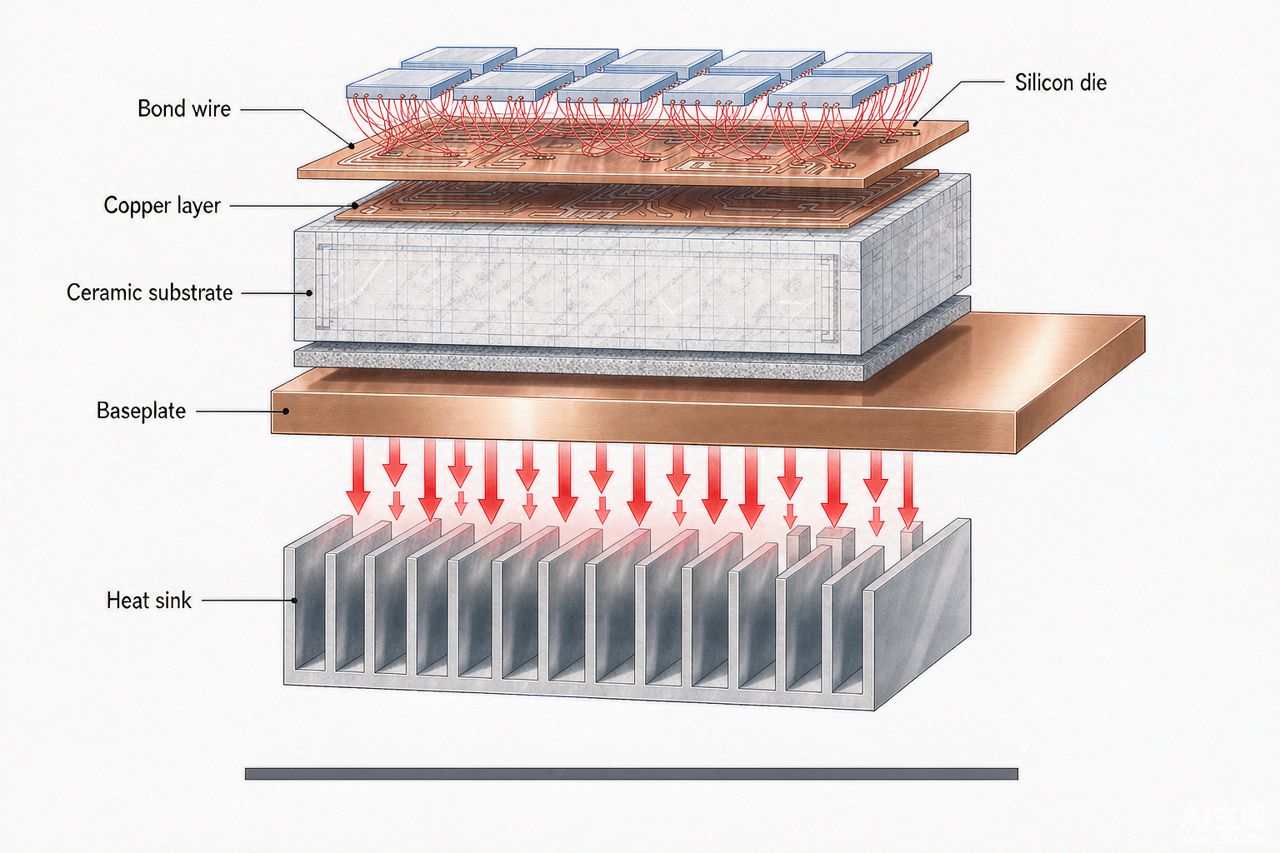
Figure: Heat flows from the silicon die through the ceramic substrate to the baseplate and heat sink.
There is no single material that is best for every power electronic application. The correct choice depends on heat generation, electrical isolation, mechanical loading, operating temperature, and the overall package structure.
AlN is generally a strong candidate when thermal management is a major design challenge. Its high thermal conductivity allows heat to move through the ceramic substrate more efficiently than conventional alumina grades.
Typical applications include:
For these applications, engineers should evaluate the required thermal conductivity grade, substrate thickness, flatness, surface finish, and metallization compatibility.
Explore Fujian Huaqing's High Thermal Conductivity AlN Ceramic Substrate for available specifications and customization options.
Alumina is suitable for many electronic applications that require reliable electrical insulation, mechanical strength, wear resistance, and heat resistance without requiring the thermal conductivity of AlN.
Different alumina grades can serve different requirements:
Fujian Huaqing offers both grades with customizable dimensions and thicknesses. The selection should be based on the actual electrical, thermal, mechanical, and manufacturing requirements of the finished component.
View the company's Alumina Ceramic Substrate range for more product details.
Before choosing between AlN and Al₂O₃, engineers and purchasing teams should review several key design factors.
Determine the power dissipation of the electronic component and the maximum allowable operating temperature. High heat flux and limited cooling space may justify using AlN, while moderate thermal requirements may be adequately addressed by alumina.
Identify the operating voltage, required insulation thickness, dielectric strength, and insulation resistance. Do not select a substrate based only on its dielectric constant.
Evaluate thermal expansion, bending strength, dimensional stability, and thermal cycling conditions. The ceramic substrate must be compatible with semiconductor chips, metal layers, solder, and other packaging materials.
Substrate thickness, length, width, flatness, surface roughness, and dimensional tolerances can affect bonding, metallization, and assembly quality. Provide detailed drawings when requesting customized ceramic substrates.
Material price is only one part of the total cost. Processing, metallization, bonding, machining, yield, thermal management requirements, and long-term reliability should all be considered. A higher-performance substrate may offer better overall value when it helps simplify the cooling design or meet demanding operating conditions.
Fujian Huaqing Electronic Material Technology Co., Ltd. has been manufacturing AlN and Al₂O₃ ceramic products since 2004. The company focuses on advanced electronic ceramic materials and substrates for applications including power modules, LED packaging, optical communication, semiconductor devices, and new energy electronics.
Its product portfolio includes:
According to its published product information, Fujian Huaqing offers AlN ceramic with thermal conductivity up to 230 W/m·K, along with various substrate dimensions and thickness options. Customers can provide technical drawings and application requirements for customized solutions.
For electronic component manufacturers, selecting a ceramic supplier involves more than comparing material names. Consistent product specifications, manufacturing capabilities, dimensional control, and technical communication are important factors in developing a reliable substrate solution.
Learn more about Fujian Huaqing Electronic Material and its electronic ceramic products.
AlN is generally more suitable for power electronic applications with demanding heat dissipation requirements because of its significantly higher thermal conductivity. Al₂O₃ remains a practical option for applications where moderate thermal performance and electrical insulation are sufficient.
The AlN substrates listed by Fujian Huaqing have thermal conductivity of 170–230 W/m·K. Its 99.6% alumina substrate is specified at 29 W/m·K, while its 96% alumina substrate is specified at 24 W/m·K. Actual values depend on the selected product grade.
Yes. Aluminum nitride is an electrically insulating ceramic with high thermal conductivity. This combination makes it suitable for electronic substrates that need to transfer heat while electrically isolating conductive components.
The main difference is their alumina content and associated material properties. Higher-purity alumina generally offers different electrical, mechanical, and surface characteristics. In Fujian Huaqing's published specifications, 99.6% alumina has a thermal conductivity of 29 W/m·K, compared with 24 W/m·K for its 96% alumina product. The appropriate grade depends on the application's requirements.
Yes. Fujian Huaqing provides customization options for both materials. Customers can submit drawings specifying dimensions, thickness, surface requirements, and other technical details for evaluation.
AlN is often preferred for high-power LED packaging because its high thermal conductivity helps transfer heat away from LED components. Alumina can also be used when the thermal load and system design allow its lower thermal conductivity to meet the application requirements.
Choosing between AlN and Al₂O₃ requires a clear understanding of thermal management, electrical insulation, mechanical requirements, and manufacturing conditions. AlN is a strong option for high-performance thermal management, while alumina provides a versatile solution for many electronic and industrial applications.
Fujian Huaqing Electronic Material supplies aluminum nitride and alumina ceramic substrates with various material grades, dimensions, and customization options. Contact the technical team with your drawings and application requirements to discuss a suitable ceramic substrate solution.
Contact Fujian Huaqing Electronic Material
Website: www.huaqingcn.com
Email: kevinsze@aln.net.cn
Phone: +86 15960789288
Pourquoi vous avez besoin de nos services, vous savez que vous obtenez des professionnels hautement qualifiés qui ont l'expertise et l'expérience pour s'assurer que votre projet est fait correctement et fonctionne.
si vous souhaitez une consultation gratuite, veuillez commencer par remplir le formulaire:
Recevez des informations sur les ventes, des nouvelles et des mises à jour dans votre boîte de réception.

 闽ICP备19012761号-1