Pourquoi vous avez besoin de nos services, vous savez que vous obtenez des professionnels hautement qualifiés qui ont l'expertise et l'expérience pour s'assurer que votre projet est fait correctement et fonctionne.
Aluminum Nitride (AlN), Direct Bonded Copper (DBC), and Active Metal Brazing (AMB) are important technologies and substrate solutions used in power module packaging. However, they are not three equivalent material options. AlN is a ceramic material, while DBC and AMB are processes used to bond metal layers to ceramic substrates.
AlN is valued for its high thermal conductivity and electrical insulation. DBC uses a direct copper-to-ceramic bonding process and is widely applied in power electronic substrates. AMB uses active elements in the brazing material to create a chemical reaction layer between the ceramic and metal, providing strong bonding and good thermal cycling characteristics.
For power module applications, the selection depends on the ceramic material, operating temperature, thermal management requirements, electrical insulation, copper layer design, and reliability expectations. AlN-based AMB substrates are worth considering when both high thermal conductivity and reliable metal-to-ceramic bonding are required. DBC substrates with alumina or other suitable ceramics remain practical solutions for many power electronic designs.
Aluminum Nitride (AlN) is an advanced technical ceramic widely used in electronic packaging because it combines high thermal conductivity with electrical insulation. Unlike conventional alumina ceramics, AlN can transfer heat more efficiently, making it suitable for electronic devices with concentrated heat generation.
In power module packaging, ceramic substrates provide electrical isolation between conductive circuit layers and the underlying cooling or mounting structures. At the same time, they must transfer heat generated by semiconductor chips to the thermal management system.
AlN is particularly useful when a power module requires both efficient heat dissipation and electrical insulation. Its relatively low coefficient of thermal expansion also makes it attractive for electronic packaging designs that require compatibility with silicon-based semiconductor components.
According to Fujian Huaqing Electronic Material's published specifications, its AlN ceramic substrates have:
These properties make AlN a suitable ceramic material for power module substrates, LED packaging, and other electronic components that require effective heat dissipation.
However, a bare AlN ceramic substrate is not the same as an AlN-based DBC or AMB substrate. In a metallized substrate, the ceramic is combined with copper or other metal layers to form the electrical circuit and provide connections for semiconductor components.
Explore Fujian Huaqing's High Thermal Conductivity AlN Ceramic Substrate for more product specifications.
DBC stands for Direct Bonded Copper. It is a metallization technology that joins copper foil directly to a ceramic substrate through a high-temperature bonding process.
During the manufacturing process, copper and ceramic are bonded under controlled conditions to create a composite structure. The copper layers form conductive circuits, while the ceramic layer provides electrical insulation and contributes to heat transfer.
A typical DBC substrate has a three-layer structure:
DBC substrates are used in power semiconductor modules, thermoelectric cooling modules, electronic heating devices, power control circuits, and power hybrid circuits.
The DBC process uses a direct bonding mechanism between copper and ceramic. In conventional DBC manufacturing, controlled high-temperature conditions promote bonding at the copper-ceramic interface.
One important characteristic of DBC is that the ceramic material and copper layers form a composite structure without relying on the same active-metal brazing mechanism used in AMB.
The bonding quality is important because the interface must withstand electrical, thermal, and mechanical stresses during module operation.
Fujian Huaqing's published DBC product information lists Alumina and ZTA ceramic substrates. The company's product specifications include the following copper/ceramic/copper combinations:
| DBC Type | Copper/Ceramic/Copper (mm) |
|---|---|
| Al₂O₃-DBC | 0.20/0.38/0.20 |
| Al₂O₃-DBC | 0.25/0.38/0.25 |
| Al₂O₃-DBC | 0.30/0.38/0.30 |
| Al₂O₃-DBC | 0.20/0.64/0.20 |
| Al₂O₃-DBC | 0.25/0.64/0.25 |
| Al₂O₃-DBC | 0.30/0.64/0.30 |
| ZTA-DBC | 0.20/0.32/0.20 |
| ZTA-DBC | 0.25/0.32/0.25 |
| ZTA-DBC | 0.30/0.32/0.30 |
These dimensions represent the copper, ceramic, and copper layer thicknesses, respectively. They are published product configurations rather than a complete list of all possible customized dimensions.
For example, a 0.20/0.38/0.20 mm DBC substrate consists of a 0.20 mm top copper layer, a 0.38 mm ceramic layer, and a 0.20 mm bottom copper layer.
View the DBC Ceramic Substrate for Power Electronics product page for more information.
AMB stands for Active Metal Brazing. It is a ceramic-to-metal joining technology that uses active elements in the brazing material to promote bonding between ceramic and metal layers.
Unlike conventional DBC, which uses a direct copper bonding process, AMB relies on a chemical reaction between the active metal brazing material and the ceramic surface.
Small amounts of active elements such as titanium (Ti) and zirconium (Zr) can react with the ceramic to form an interfacial reaction layer. This layer allows the brazing material to wet the ceramic surface and establish a strong metal-to-ceramic connection.
This bonding mechanism is particularly relevant in power modules, where the ceramic-metal interface must withstand repeated thermal changes and mechanical stresses.
The general AMB manufacturing process involves several important stages:
The resulting AMB substrate provides a metal-ceramic composite structure with strong interfacial bonding. Its suitability for a particular power module depends on ceramic composition, brazing material, process parameters, and final substrate design.
Fujian Huaqing's AMB product pages list several ceramic material options, including:
The company's published AMB copper/ceramic/copper specifications include:
| AMB Type | Copper/Ceramic/Copper (mm) |
|---|---|
| AlN-AMB | 0.30/0.38/0.30 |
| AlN-AMB | 0.30/0.64/0.30 |
| Si₃N₄-AMB | 0.25/0.32/0.25 |
| Si₃N₄-AMB | 0.30/0.32/0.30 |
| Si₃N₄-AMB | 0.80/0.32/0.80 |
| Si₃N₄-AMB | 1.20/0.32/1.20 |
| ZTA-AMB | 0.30/0.32/0.30 |
| ZTA-AMB | 0.40/0.32/0.40 |
The specifications show that AMB substrate designs can use different ceramic thicknesses and copper layer configurations. The appropriate structure depends on current capacity, heat transfer, electrical isolation, mechanical stress, and the module's packaging design.
Fujian Huaqing also identifies high bonding strength and cold and thermal cycling characteristics as important features of its AMB ceramic substrates.
Explore the AMB Ceramic Substrate for Power Modules product range.
Although both DBC and AMB produce metalized ceramic substrates, their bonding mechanisms are different. Understanding these differences helps engineers evaluate which technology is more suitable for a particular power module.
| Comparison | DBC | AMB |
|---|---|---|
| Full Name | Direct Bonded Copper | Active Metal Brazing |
| Bonding Mechanism | Direct copper-to-ceramic bonding | Active metal brazing and interfacial chemical reaction |
| Bonding Material | Copper and ceramic interface | Active metal brazing material |
| Ceramic Options on Huaqing's Product Pages | Alumina, ZTA, Si₃N₄ | AlN, Alumina, ZTA, Si₃N₄ |
| Bonding Characteristics | Direct bonding interface | Reactive interfacial bonding |
| Key Design Considerations | Copper thickness, ceramic selection, interface quality | Brazing material, ceramic compatibility, reaction layer, interface quality |
| Typical Applications | Power semiconductor modules, power control circuits | High-power modules, automotive electronics, renewable energy systems |
Neither process is universally better. DBC can be an appropriate solution for designs with established direct bonding requirements. AMB is worth evaluating when the application requires active-metal bonding and specific ceramic-metal interface performance.
The final decision should be based on actual thermal cycling conditions, copper thickness, ceramic material, bonding strength requirements, and reliability testing.
Selecting a ceramic substrate involves evaluating the complete power module rather than looking at one material property in isolation. The following factors are especially important.
Power semiconductor devices generate heat during switching and conduction. The ceramic layer must transfer this heat toward the cooling structure while maintaining electrical isolation.
AlN is a strong candidate when high thermal conductivity is required. Fujian Huaqing specifies thermal conductivity of 170–230 W/m·K for its AlN ceramic products.
However, the thermal performance of a complete DBC or AMB substrate also depends on ceramic thickness, copper layers, bonding interfaces, and the thermal properties of the surrounding package.
Power modules frequently experience temperature changes during operation. Repeated heating and cooling can generate mechanical stress because different materials expand and contract at different rates.
The copper-ceramic interface is therefore an important reliability consideration. AMB uses active-metal brazing to establish a reaction layer that supports ceramic-to-metal bonding. DBC uses direct copper bonding and must also maintain interface integrity during thermal cycling.
Engineers should evaluate thermal cycling requirements, bonding strength, interface quality, and the compatibility of the selected ceramic and metal layers.
The ceramic material influences thermal conductivity, electrical insulation, mechanical behavior, and thermal expansion.
The compatibility of each ceramic with the chosen DBC or AMB process should be confirmed with the substrate manufacturer.
Copper thickness affects electrical current capacity, heat spreading, mechanical stress, and circuit pattern design.
Thicker copper layers may support higher current requirements, but they also affect the mechanical behavior of the composite substrate during temperature changes.
Therefore, the copper/ceramic/copper configuration should be selected according to current loading, circuit layout, thermal requirements, and module dimensions rather than simply choosing the thickest available copper layer.
Power module substrates often require precise dimensions and controlled surface conditions to ensure compatibility with semiconductor chips, soldering processes, and cooling assemblies.
Important requirements include:
Providing engineering drawings and application details at the quotation stage helps the manufacturer evaluate the correct material and substrate structure.
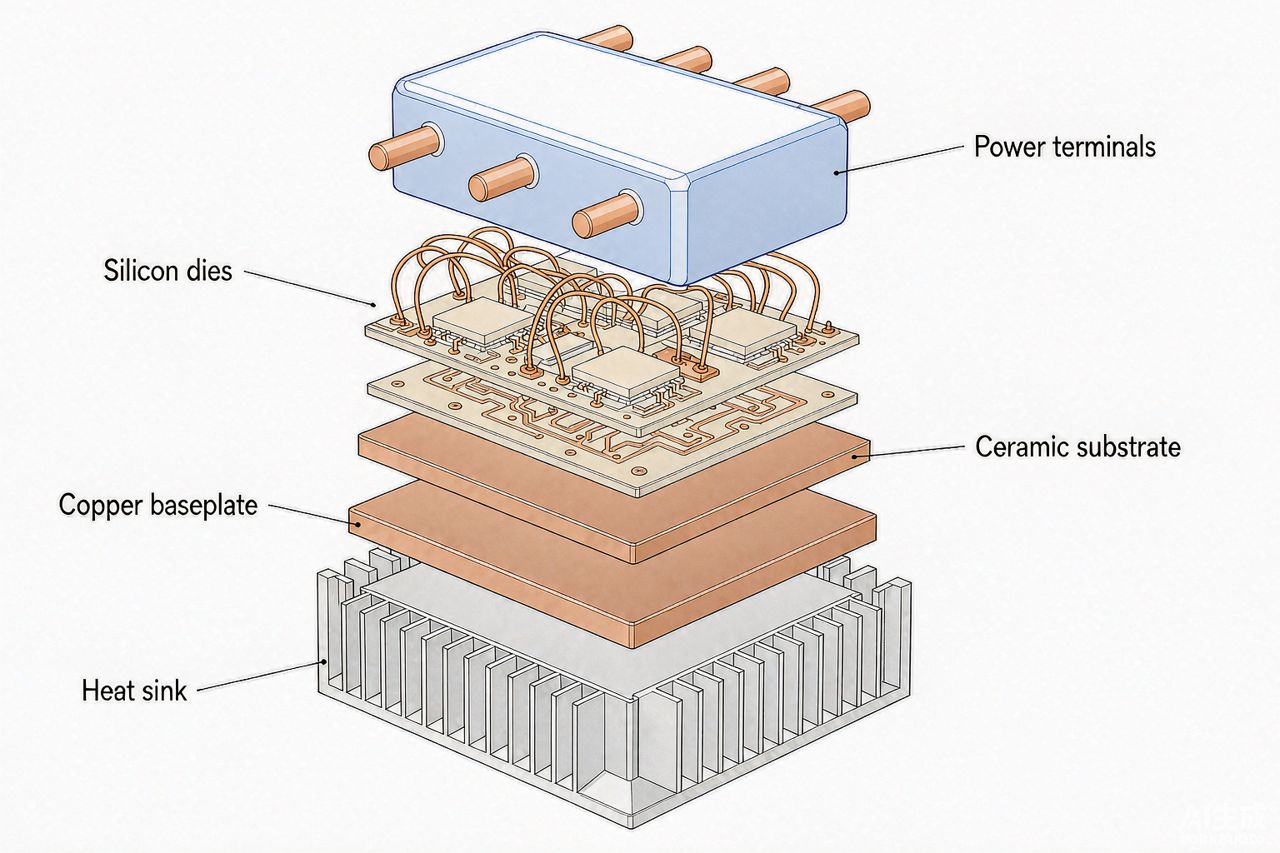
Figure: A power module stack using a DBC or AMB ceramic substrate between the copper circuit and baseplate.
DBC and AMB substrates are used in different power electronic systems where electrical isolation, heat dissipation, and reliable metal-ceramic bonding are required.
IGBT modules are widely used in industrial motor drives, power conversion equipment, renewable energy systems, and transportation applications. Their semiconductor chips generate heat during operation, making the thermal performance of the substrate an important design consideration.
DBC and AMB ceramic substrates provide electrical insulation and conductive copper layers for power module packaging. The appropriate solution depends on voltage, current, thermal cycling, and mechanical reliability requirements.
Electric vehicle power electronics, including inverter systems and motor control units, operate under changing electrical and thermal loads. Ceramic substrates help provide insulation and heat transfer within these electronic assemblies.
AMB substrates can be considered for applications with demanding bonding and thermal cycling requirements, while DBC remains an established option for many power electronic designs.
Solar inverters, wind power converters, and other energy conversion systems rely on power semiconductor devices to control electrical energy. Their substrates must support electrical isolation, heat dissipation, and reliable operation under repeated load changes.
Both DBC and AMB technologies can be used in power module designs for renewable energy equipment, depending on the system's technical requirements.
Industrial power converters, high-frequency switches, and power control systems require ceramic substrates that can support electrical circuits and transfer heat away from semiconductor components.
The choice between DBC and AMB should consider the operating environment, circuit configuration, and required service reliability.
Fujian Huaqing Electronic Material Technology Co., Ltd. has been manufacturing advanced electronic ceramic products since 2004. Its product portfolio includes aluminum nitride ceramics, alumina ceramics, metallized ceramic substrates, and customized electronic ceramic components.
The company's DBC and AMB product ranges support different ceramic materials and copper layer configurations for power module applications.
Its published product information includes:
For manufacturers developing IGBT modules, power semiconductor packages, and other electronic assemblies, working with a supplier that understands ceramic materials and metallization requirements can help improve material selection and product development efficiency.
Fujian Huaqing can evaluate customer drawings and application requirements to discuss suitable ceramic materials, substrate dimensions, and metal layer configurations.
Visit the company's Metalization Ceramic product category to explore its DBC and AMB substrate solutions.
DBC uses a direct copper-to-ceramic bonding process, while AMB uses active metal brazing material containing reactive elements to form a chemical reaction layer at the ceramic-metal interface. Both technologies create metallized ceramic substrates, but their bonding mechanisms are different.
AlN is a ceramic material, not a bonding process. It can be used as the ceramic layer in an AMB substrate. Whether a particular AlN grade is suitable for another metallization process depends on the manufacturing technology and product design.
AlN combines high thermal conductivity with electrical insulation. These properties help transfer heat away from power semiconductor components while maintaining electrical isolation. Fujian Huaqing specifies thermal conductivity of 170–230 W/m·K for its AlN ceramic substrates.
Common ceramic options include aluminum nitride (AlN), aluminum oxide (Al₂O₃), zirconia toughened alumina (ZTA), and silicon nitride (Si₃N₄). Fujian Huaqing lists these four materials in its AMB product information. Actual compatibility depends on the brazing system and manufacturing conditions.
DBC ceramic substrates are used in power semiconductor modules, power control circuits, thermoelectric cooling modules, electronic heating devices, and power hybrid circuits. They combine conductive copper layers with an electrically insulating ceramic layer.
Customers should provide substrate drawings, ceramic material requirements, overall dimensions, ceramic thickness, copper thickness, circuit patterns, dimensional tolerances, and application conditions. These details help the manufacturer evaluate the appropriate substrate structure.
AlN, DBC, and AMB serve different roles in power module packaging. AlN provides the ceramic material properties, while DBC and AMB define different approaches to joining copper layers with ceramic substrates.
Choosing the right solution requires evaluating thermal conductivity, electrical insulation, bonding characteristics, thermal cycling, copper thickness, and manufacturing tolerances together.
Fujian Huaqing Electronic Material supplies AlN ceramic, DBC substrates, and AMB ceramic substrates for electronic and power module applications. Contact the technical team with your product drawings and application requirements to discuss a customized solution.
Contact Fujian Huaqing Electronic Material
Website: www.huaqingcn.com
Email: kevinsze@aln.net.cn
Phone: +86 15960789288
Pourquoi vous avez besoin de nos services, vous savez que vous obtenez des professionnels hautement qualifiés qui ont l'expertise et l'expérience pour s'assurer que votre projet est fait correctement et fonctionne.
si vous souhaitez une consultation gratuite, veuillez commencer par remplir le formulaire:
Recevez des informations sur les ventes, des nouvelles et des mises à jour dans votre boîte de réception.

 闽ICP备19012761号-1